Deck and fence repair in Wilmington, NC is not a seasonal concern — it is a year-round reality. The Cape Fear coast is one of the more demanding environments for outdoor wood structures anywhere in the Southeast. Moisture never fully leaves the air. Salt blows in from the ocean and settles into wood grain, metal fasteners, and concrete footings. Summers bring intense UV that dries and grays wood faster than most owners expect. Hurricanes and tropical systems load decks with wind and rain that finds every fastener and joint already weakened by the prior season. Yurii Statkevych has repaired hundreds of decks and fences across Wilmington and the surrounding communities over 15 years, and the pattern is consistent: small problems caught early are inexpensive repairs; the same problems left alone for two more seasons become structural failures.
What deck and fence repair actually involves
The phrase “deck repair” covers a wide range of work, from replacing two splintered boards to rebuilding a railing system, repouring a rotted post footing, and re-decking an entire surface. Understanding the full scope of what can go wrong — and what each problem requires — helps homeowners plan and budget accurately.
Deck board replacement
Individual deck boards rot from the surface down, or more commonly from beneath where water pockets between the board and the joist below. Pressure-treated pine boards that have been left unfinished or allowed to go years without sealant are the most vulnerable. Composite decking is more rot-resistant but can crack, delaminate, or develop surface mold in persistent moisture.
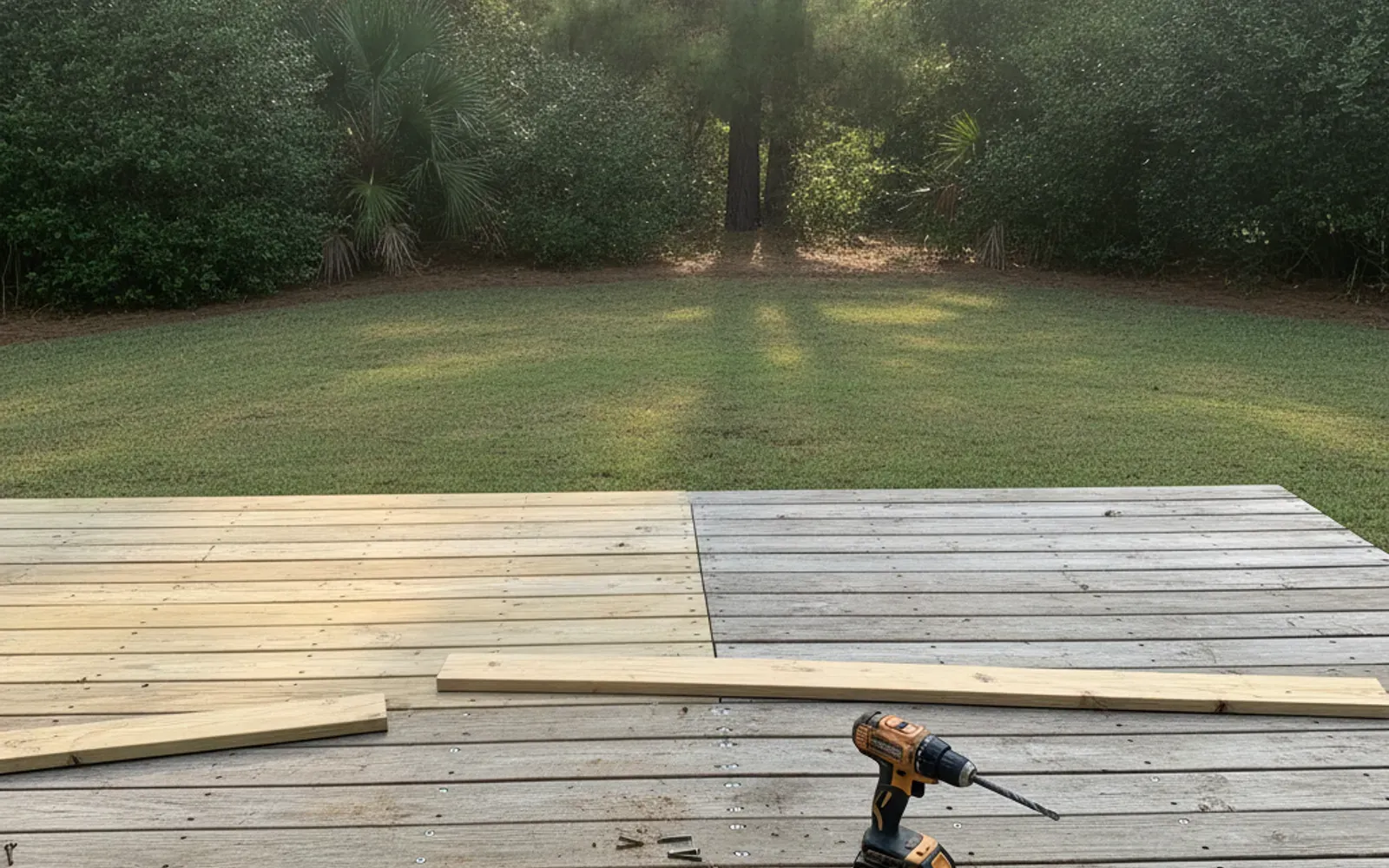
Replacing boards correctly means removing fasteners — screws or hidden clips — cutting the board cleanly at the joist centerlines so the joint is supported, and installing the replacement board so it sits flush without gaps that collect water. Matching lumber species, thickness, and width to the existing boards matters both visually and structurally.
Railing repair and replacement
Deck railings fail in several different ways. Wood balusters rot at the base where they contact the decking surface. Post bases corrode or the wood around the base hardware softens. Top rails split along the grain and begin to separate. Cable railing turnbuckles loosen over time and lose tension.
A railing that wobbles is not just an eyesore — it is a safety issue, especially on elevated decks above grade. Yurii checks every post base and baluster during an estimate, distinguishing cosmetic looseness from structural failure. Post replacement typically involves removing the post base hardware, sistering or replacing the adjacent framing as needed, and reinstalling with proper hardware rated for exterior use.
Ledger board and joist inspection
The ledger board is the deck’s connection to the house — a horizontal member bolted through the siding and sheathing into the rim joist of the home’s floor system. Water infiltration at the ledger is one of the leading causes of deck collapse. Where flashing was not installed correctly or has failed, wood rot can work its way into both the ledger and the house structure before it is visible from above.
Yurii inspects ledger boards and accessible joists during every deck estimate. When deterioration is present, addressing it early prevents the problem from migrating into the house framing.
Fence board, picket, and post repair
Wood privacy fences in Wilmington typically fail at the posts first. Fence posts are set in the ground with concrete, and the zone where the treated wood meets the concrete at grade level is where moisture consistently concentrates. Over years, the post softens at that point and the fence begins to lean.
Leaning fences that still have sound boards above grade can often be saved by replacing just the posts — digging out the old concrete footing, setting a new pressure-treated post, and bracing it properly while the concrete cures. Fences with boards that have gone soft, warped severely, or pulled their fasteners out need board-level replacement.
Gates are their own category. A gate that sags or drags on the ground has usually lost its hinge set to corrosion, had its post drift out of plumb, or had its frame members swell and shift. Rehavng and realigning a gate — adding a turnbuckle diagonal brace and adjusting the hinges — is a repair that lasts. Simply rehinging without addressing the frame or post accomplishes little.
Warning signs your deck or fence needs attention now
Homeowners often notice visual cues but underestimate the urgency. These signs indicate the problem has already progressed to where professional assessment is needed:
A soft or spongy feel underfoot on a deck board — even a small area — indicates rot that is likely larger than the surface suggests. Rot spreads laterally through wood grain.
Fastener heads that are pulling through the board surface, or visible gaps between boards and joists, indicate the wood around the fasteners has deteriorated enough that the connection is failing.
Railings that move more than a fraction of an inch when pushed indicate post bases or baluster connections have failed and are no longer providing meaningful restraint.
Fence posts that lean more than a couple of inches from vertical, or that can be rocked by hand at the base, have reached the point where the next windstorm will likely push them further.
Gate hardware that has rusted to the point of discoloration or has hairline cracks in the casting is close to failure — replacing it before it breaks is far less disruptive than dealing with a gate that will not close at all.
DIY deck repair versus hiring a pro
Many homeowners are comfortable replacing one or two deck boards and consider it a weekend project. For straightforward surface board replacement on a ground-level deck with accessible joists, this is often reasonable. The complications arrive in a few specific situations.
Material selection matters more than it looks on the shelf. Pressure-treated lumber comes in several retention levels for different use cases — ground contact, above ground, and deck boards — and using the wrong retention level for a given application leads to early failure even in treated wood.
Post and railing repairs that involve structural members — posts, beams, and ledger boards — carry safety implications that make professional assessment worthwhile. An incorrectly repaired post base or ledger can fail suddenly rather than gradually.
Stain and sealant application on freshly repaired or replaced boards requires proper surface preparation: the right moisture content in the wood, correct cleaning, and appropriate product for the specific material. Applied wrong, even quality products peel within a season.
What affects repair cost in Wilmington
The scope of damage is the primary driver. A four-board surface replacement is a different job from replacing twelve boards plus two posts and refinishing the entire surface. Other factors include the specific materials involved — composite decking costs more per linear foot than pressure-treated pine — and access. A deck that sits six feet above grade requires working from a ladder on the underside, which adds time and care to joist and ledger work.
Finishing — stain or sealant application — adds cost but also extends the life of the repair significantly. In coastal conditions, an unfinished or under-finished repair will show deterioration within one or two seasons.
Coastal living and what it means for wood structures
Homes within a mile or two of the ocean in Wrightsville Beach, Carolina Beach, and Kure Beach deal with noticeably accelerated salt corrosion. Metal fasteners rust faster; wood exposed to salt spray needs protection more frequently. Stainless steel or hot-dipped galvanized fasteners are the correct choice for these environments, and Yurii uses them as the standard rather than the exception.
Inland communities like Leland and Hampstead have a slightly different challenge — less salt but often heavier vegetation and shade, which keeps wood wetter for longer and promotes fungal growth. Dense Bermuda grass and landscaping that holds moisture against fence posts accelerates post rot at the base.
Older neighborhoods in central Wilmington often feature original-era decks and fences that have been patched repeatedly over decades rather than addressed systematically. These structures sometimes need a comprehensive pass — replacing all the compromised elements at once — rather than another round of spot repairs.
Related services
After deck boards are replaced and the surface is clean, deck staining and sealant application through Yurii’s painting and finishing services is the natural next step. Pressure washing before staining ensures the surface is free of mildew and salt residue so the finish adheres correctly. Gaps in deck perimeter caulking or siding at the ledger area call for caulking and weatherproofing to prevent water from working behind the structure. For any trim or wood detail work adjacent to the deck, carpentry covers fascia, stair stringers, and built-in features. General home repairs rounds out any additional items identified during the estimate walk-through.
Frequently asked questions about deck and fence repair
How much does deck repair cost in Wilmington, NC?
The cost varies widely depending on how many boards need replacement, whether structural members like posts or the ledger are involved, and what finishing work follows the repair. Yurii provides free on-site estimates after walking the deck with you — that is the only honest way to price a repair accurately. Contact Yurii to set up a walk-through.
How long does deck repair take?
Surface board replacements on a typical residential deck often complete in a single day. Larger repairs involving multiple posts, railing systems, or ledger work may take two days. Staining or sealing after the repair typically requires the surface to be dry before the finish is applied, which may add a day depending on weather.
What type of wood is best for deck repairs in coastal North Carolina?
Pressure-treated pine rated for ground contact at posts and above-ground exposure for deck boards is the standard choice. Composite decking is an excellent upgrade option — it does not rot, splinter, or need annual sealing — and is worth considering when replacing more than a few boards. Yurii can discuss both options and their long-term costs during the estimate.
Can a leaning fence post be fixed without replacing the whole fence?
Often yes. If the fence boards above are in good shape and the issue is isolated to the post or its footing, Yurii can replace the post and reset the footing while preserving the existing fence boards. A thorough assessment is necessary to confirm how far the rot or shifting has spread.
How often should I seal or stain my deck in Wilmington?
Every one to two years for penetrating stain in coastal conditions, and every two to three years for solid stain or high-quality sealant. The high UV index, salt exposure, and humidity in the Wilmington area deplete finish faster than inland climates. Visual cues — graying wood, water no longer beading on the surface, visible checking or cracking — indicate the finish has been depleted and protection has lapsed.
Will my fence survive hurricane season?
A well-maintained fence with plumb posts set in solid concrete footings handles most wind events reasonably well. Privacy fences are inherently wind-loaded structures, and some loss of boards in a strong storm is not unusual even on well-built fences. The critical factor is post integrity — a fence with solid posts loses boards but stays up; a fence with rotted or under-footed posts tends to fall as a section when wind loads it.
Do you handle fence repairs for both wood and vinyl fences?
Yurii primarily works on wood privacy fences, picket fences, and the framing behind vinyl fence panels. Vinyl fence board and post replacement uses similar approaches — pulling compromised sections, setting replacement material, and ensuring hardware fits correctly. The post-in-ground fundamentals are the same regardless of material.
A deck or fence that wobbles today is a bigger repair next season. Get a free estimate and find out exactly what your structure needs — Yurii will walk it with you and give you a straight answer, not a sales pitch.