Senior safety modifications and aging-in-place upgrades in Wilmington, NC address one of the most important practical questions a family faces: how do you make sure an older person can stay safely and comfortably in their own home as mobility changes? The answer is rarely a single dramatic renovation. It is usually a collection of targeted, correctly installed modifications — grab bars anchored into studs, a handrail on the side of the stairs that never had one, a threshold ramp over the lip of a raised front door, motion-sensor lights along the midnight path from bedroom to bathroom — that collectively remove the hazards that cause falls.
Falls are the leading cause of injury-related hospitalization for adults over 65 in the United States. The majority happen at home. The majority are preventable with modifications that cost far less than a single emergency room visit. Yurii has spent years installing exactly these modifications across Wilmington and the surrounding coastal communities, and he brings to every one of them the same principle: the hardware has to work when it is actually needed, under real load, by someone who is depending on it.
The full scope of aging-in-place modifications
Grab bar installation in bathrooms
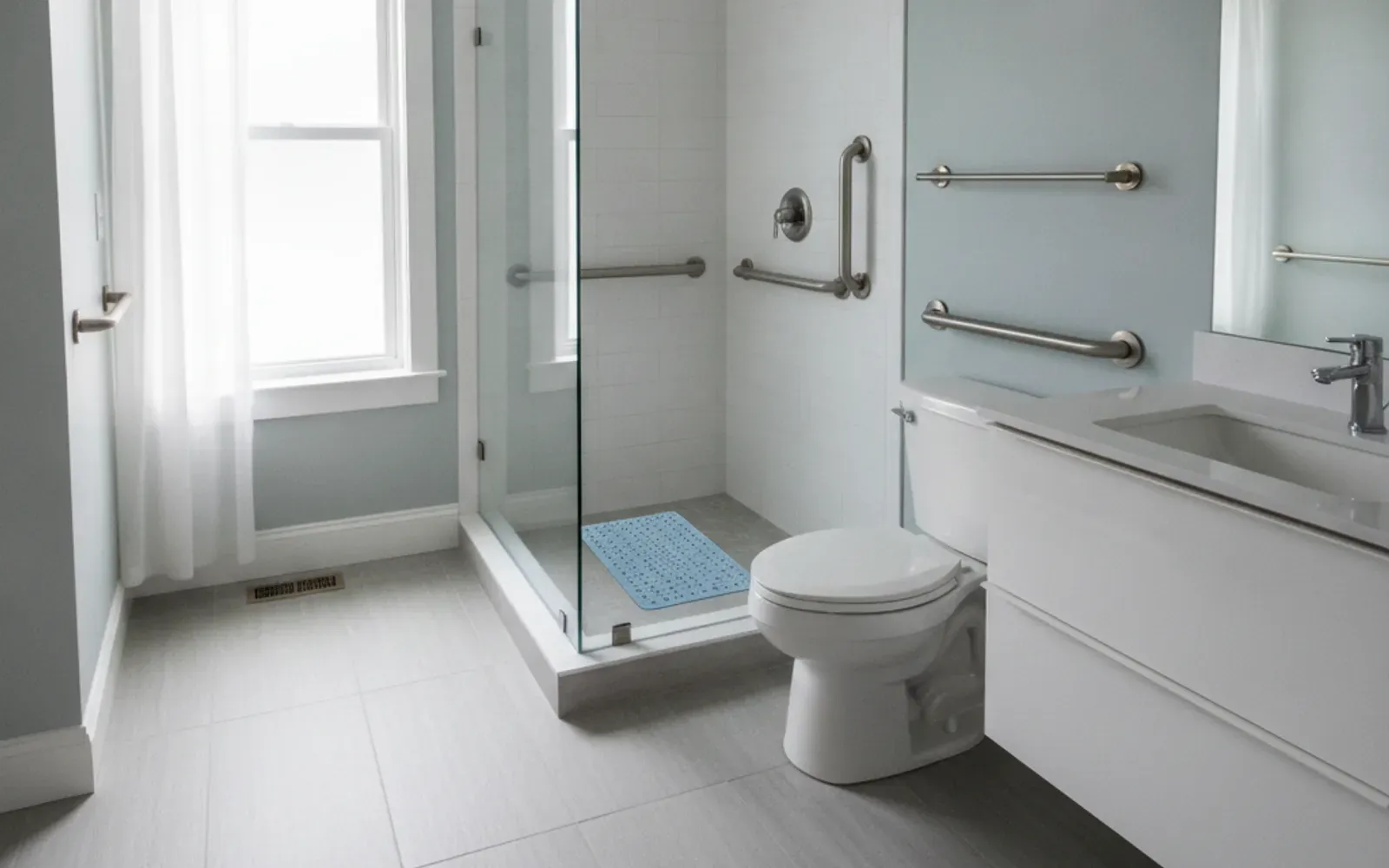
The bathroom is statistically the most dangerous room in the home for older adults. Wet, hard surfaces, transitions from floor to tub or shower, and the physical positions required for bathing and toileting all combine to create fall risk. Correctly installed grab bars address the primary hazard.
The critical word is “correctly.” Grab bars are only useful if they hold. A bar fastened into drywall alone with toggle bolts can pull out under a hard grip, which is precisely the moment when someone most needs it to hold. Every grab bar Yurii installs goes into wall studs or into solid blocking — either existing blocking in newer construction or blocking he adds during the installation. The flanges use the correct screw type and length for rated load capacity. Before leaving, Yurii applies his full body weight to each bar to confirm it does not flex, shift, or sound hollow.
Common placements: along the inside wall of a walk-in shower, on the wall beside the toilet for sit-to-stand assistance, on the transfer wall of a bathtub, and along the entry wall of the bathroom for balance support.
Bar styles include straight horizontal bars, angled bars, and flip-down bars that fold against the wall when not in use. The right choice depends on the specific location, the tile or wall surface, and the user’s particular mobility patterns.
Handrail addition and reinforcement
Many older Wilmington homes — particularly the bungalows, ranches, and beach cottages across the area — have stairs that were built with handrails on only one side, or with rails that were never anchored as robustly as they should have been. Adding a handrail to the open side of a staircase, or reinforcing an existing rail that has developed play in the wall brackets, is one of the most impactful single modifications possible.
For exterior stairs, which are exposed to Wilmington’s salt air, humidity, and UV, Yurii recommends aluminum or composite rail material where appropriate. Wooden exterior rails need more frequent inspection and treatment in coastal environments than they would inland.
Threshold ramps and doorway accessibility
Wilmington has a significant stock of older homes and coastal cottages that were built with raised entries — sometimes a single step up from the exterior landing, sometimes a half-step threshold lip inside the house between rooms. For someone using a walker or wheelchair, or for anyone whose balance and step height are becoming less reliable, these transitions are disproportionate hazards.
Threshold ramps — rubber, aluminum, or modular composite, ranging from half-inch lip covers to multi-inch approach ramps — convert these transitions into accessible slopes. For beach communities like Kure Beach and Carolina Beach, where many older homes sit on pilings and have elevated entries, this often means a more substantial ramp installation at the primary entry point, which Yurii assesses and quotes specifically.
Lever-style door handles and faucet hardware
Round doorknobs require grip strength and wrist rotation that becomes difficult with arthritis. Lever handles require only a push or pull. Replacing every doorknob in a home with lever-style hardware is a low-cost, high-impact modification that immediately improves daily independence. The same principle applies to faucet handles — replacing cross-handle or round-knob faucet controls with single-lever or paddle-style handles in the bathroom and kitchen.
Door and lock installation work overlaps here, and Yurii handles the full scope in a single visit.
Motion-sensor and night lighting
The path from a bedroom to the bathroom at 2 a.m., navigated half-awake without reaching for a switch, is a genuine fall hazard. Motion-activated plug-in night lights along hallways and in bathrooms address this without any wiring work. For more permanent solutions, Yurii installs motion-activated light switches that illuminate a hallway automatically when movement is detected. These light electrical modifications are among the least disruptive and most immediately useful changes a home can have.
Comfort-height toilet installation
Standard toilets sit at 14 to 15 inches from floor to seat. Comfort-height or ADA-compliant toilets sit at 17 to 19 inches — closer to chair height and dramatically easier for seniors with hip, knee, or strength limitations to use. Toilet installation is within Yurii’s light plumbing scope, and the combination of a comfort-height toilet with a correctly placed grab bar beside it represents one of the most effective single-bathroom modifications possible.
Wilmington-area homes and aging-in-place considerations
The Wilmington area’s housing stock creates specific contexts for accessibility work. Historic downtown Wilmington homes are often two or three stories with steep staircases, narrow doorways, and tile or hardwood throughout — all surfaces that amplify fall risk. Coastal cottages in Wrightsville Beach and Carolina Beach frequently sit on pilings with elevated entries and exterior stairs that see heavy UV and salt exposure. Newer construction in communities like Porters Neck and Leland tends to have wider doorways and single-story layouts that are more accessible from the start, though bathrooms still benefit from properly anchored grab bars regardless of construction age.
The warm Wilmington climate — mild winters, long outdoor seasons — means that exterior access is genuinely important year-round. An outdoor ramp or rail that works well in October also needs to work in a July afternoon rainstorm. Yurii selects hardware with the coastal exposure in mind.
For families whose aging parent lives in a Hampstead or Ogden community and wants to stay there long-term, a comprehensive safety walkthrough covers both the obvious modification points and the subtler hazards — loose throw rugs, inadequate lighting, furniture arrangements that create navigation obstacles.
Who benefits from a safety modification visit
This service serves several groups beyond the immediate image of an elderly person living alone. Adult children arranging modifications at a parent’s home before a visit or as a proactive gift. Couples in their 60s planning for the next decade in their current home. Homeowners recovering from a hip or knee surgery who need temporary or permanent bathroom modifications. Short-term rental operators who want to make a beach house accessible for guests who use mobility aids. Yurii handles all of these with the same practical, respectful approach.
Related services
A comprehensive aging-in-place project often involves more than one category of work. Light electrical covers motion sensors, switched outlets, and nightlight installations. Door and lock installation handles lever hardware upgrades and any door width concerns. General home repairs addresses the maintenance items — loose railings, stuck doors, uneven thresholds — that become more significant fall hazards over time. Caulking and weatherproofing matters for wet-area surfaces in bathrooms where water intrusion could create slip hazards around the tub surround.
Frequently asked questions about senior safety and accessibility modifications in Wilmington
How do I know which modifications my parent’s home actually needs?
A free in-home walkthrough is the most useful starting point. Yurii assesses the home with fall risk in mind — bathroom surfaces and transitions, staircase handrail coverage, nighttime path lighting, doorway thresholds, exterior entries — and gives you a prioritized list rather than quoting everything at once. The goal is to address the highest-risk items first. Get a free estimate to schedule that walkthrough.
Are there specific grab bar brands or styles you recommend for coastal homes?
In coastal environments, Yurii recommends stainless steel or high-quality coated grab bars over chrome-plated steel. Chrome plating is more susceptible to pitting and corrosion in salt air, particularly in bathrooms that have outdoor-ventilating windows. Stainless steel costs modestly more but lasts significantly longer in a coastal home. For most clients, the difference in bar cost is the smallest part of the total job price.
How do you install a grab bar where there is no stud behind the tile?
When tile walls are involved and studs are not in the ideal location, there are two correct solutions: toggler bolt systems specifically rated for grab bars (these distribute load through the wall panel properly, unlike generic toggle bolts), or the preferred approach of adding blocking behind the tile surface — which involves opening the wall, installing solid wood blocking between the studs, patching and retiling or re-paneling the surface, and then installing the bar into the blocking. Yurii will assess the wall construction and recommend the right approach for the specific situation.
Can these modifications be reversed later if needs change?
Most modifications are reversible. Grab bars can be removed and the wall patched. Lever door handles can be swapped back to knobs. Threshold ramps are typically not permanent. Night lights are plug-in. The modifications that involve some level of permanent work — blocking behind tile, ramp installation with fastened sections — can still be removed with some restoration effort. This is rarely a practical concern, but it is worth understanding.
Does Medicare or Medicaid cover home safety modifications?
Medicare generally does not cover home modification costs directly, but some Medicare Advantage plans include home safety benefits. Medicaid waiver programs in North Carolina sometimes include home modification allowances for qualifying participants. Veteran’s benefits through the VA include home modification grants for eligible veterans with service-connected disabilities. Yurii does not handle insurance billing — a social worker, elder care coordinator, or benefits counselor is the right resource for navigation — but many families self-pay because the cost of prevention is a fraction of the cost of a fall.
How long does a typical senior safety modification visit take?
A straightforward bathroom visit — two or three grab bars, a lever faucet handle, and a night light — typically takes two to three hours including the time to confirm stud locations, select mounting points with the homeowner, install, and test under load. A comprehensive home walkthrough with modifications in multiple rooms can take a full day, depending on scope. Yurii estimates time honestly in the quote so you can plan accordingly.
Do you work with home care agencies or elder care coordinators in the Wilmington area?
Yurii is happy to coordinate with home care agencies, occupational therapists, or elder care coordinators who have already assessed a client’s home and prepared a modification list. If an OT has specified grab bar placement, bar length, and weight rating, Yurii works from that specification. Contact Yurii to discuss how to coordinate with your care team.